Tuesday, May 8, 2012

Bryce Canyon, Part 3

By careful observation, I have decided that the Peekaboo Loop at Bryce Canyon is taken mostly by people in their 20s, and that they are absolutely the most beautiful and handsome group that could be found anywhere. Perhaps there is a special gate through which they have passed, and middle-aged people like us are not required to use it. But at the young adult's gate, the park rangers carefully eliminate trail access to anyone who is just average looking, and also to those with piercings or bright purple hair. I highly suspect that as these 20-somethings finish their climb back up to the top of the canyon, radiant with the glow of good health, modeling agencies and movie producers are waiting there to sign them all up for lucrative careers.


Reinvigorating view from the Peekaboo Loop 

Hoodoos, too

Bryce Canyon, Part 2


Great Husband and I hiked our legs off on Monday, which is noteworthy because I am by nature sedentary. Our chosen route was 6.4 miles total, and started with Queen’s Garden Trail, followed by the strenuous Peekaboo Loop, with many ups and downs and plenty of vertical change, and finished by Navajo Trail, an intense climb up with many switchbacks. This combination is called “the ultimate hike” in the Bryce Canyon guide, and is described as taking 4-5 hours. We took seven hours instead, with many stops to recover our breath because of the high elevation here (7100 to a little over 8000 feet). Fortunately the weather was absolute perfection and the trail is replete with frequent shady zones for nice breaks. We also had every hiker's necessity with us -- peanut butter sandwiches.


Hoodoos 

Queen's Garden Trail

Steller's Jay hoping for crumbs
Growing from the rocks


Bryce Canyon National Park, Part 1


It’s an easy and pretty drive between Zyon and Bryce Canyon National Park. We arrived mid-afternoon on Sunday and found a campsite in Loop B of North Campground. We like camping in coniferous forests, such as this, where the campground floor is pine needles.

Hoodoos of Bryce Canyon
A good way to get a quick orientation to Bryce is to drive the 18-mile length of the park road and stop at its many panoramic views. Since we did this just before sunset, we found ourselves nearly alone.


Bryce Canyon panoramic view
Temperatures below freezing were predicted for Sunday night, which made me somewhat nervous even though Rease had told us our various tanks and lines would be fine as long as it would get above freezing the next day. As an extra precaution we left a door open to the under-bed storage area and turned the water heater on overnight. When we first checked the outdoor temperature in the morning, it was 27 degrees F., and all was well with the water systems in the Escape.


Zion National Park, Part 2


It is always the same—we enter a new park and feel a bit overwhelmed with the unfamiliar, but by the second day we have taken temporary root and have a sense of ownership of the park.

We started this day in Zion with a ranger-led shuttle ride of 1 ½ hours. All the ranger talks in the national parks are so well done. We stopped frequently to climb out of the shuttle and learn about the geology of the park and the force of water on our surroundings, such as just how it happens that water comes seeping out of the canyon face so many places here, after a 4000-year journey through the rocks. Another fun topic was rock slides, including the story of an enormous rock which suddenly demolished a park ranger’s bedroom while he ate breakfast in the next room. We got to see scenic areas that most visitors miss because our tour stops were not the standard shuttle stops. These shuttle tours happen every morning at 9 a.m., and because they are so popular, you should sign up a day ahead.

Each place has small delights which are just not the kind of thing to be published in the park newspaper. In Zion we have been entertained by an abundance of tent caterpillars which feed on the cottonwood trees. They are pleasantly fuzzy but absolutely thick on the walks around the visitor center and creepy in such quantities. More than once Great Husband and I have found hitchhiking caterpillars on our clothes. We have also enjoyed watching lizards doing push-ups in our campsite.

We did a steep, but easy hike today, to Weeping Rock. The water seepage comes out of the rocks there, much like rain, and is a beautiful area of hanging gardens, in which plants thrive on the vertical face of the cliffs.

Both evenings in Zion, we finished with the ranger talks at the amphitheater, a very easy walk from our campsite in Watchman Loop B. Tonight’s subject was owls, and the Mexican Spotted Owl in particular, of which there are 20-25 breeding pairs here in the park.  

p.s. We were able to tow the little Escape 19 out through the 1.1 mile long tunnel, exiting on the east side of Zyon National Park. Many RVs are too big and require an escort (for a fee) because they are too wide or too long or too tall.

Basking

Ranger and Great Husband on hike to Emerald Pools

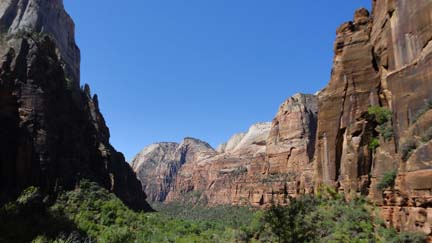
Zion grandeur

Carved by the Virgin River

Leaving Zion

Zion National Park, Part 1


Yesterday we arrived at Zion National Park in Utah for a 3-night stay. Fortunately we had a reservation in Watchman Campground. Otherwise we would have been turned away to search for a campground outside the park since Zion itself was full up.

Zion is desert country, but the canyon here is carved by the Virgin River so there is plenty of green, and varying ecosystems as the elevations change. The campground itself I would describe as scruffy, and I think that’s because at this low level cottonwood trees proliferate, and we recognize them as too much like back home and nothing drop-dead gorgeous. Oops! I forgot to look UP, where the background mountains ARE drop-dead gorgeous.

This morning a ranger taught us about birds of this area (turkey vultures, California condors, and Peregrine falcons) as we looked through his telescope at the rock face where these birds have been nesting. We learned about the rescue of the California condors from near-extinction (population 9) and how they are still threatened with lead poisoning caused when they consume fragments of lead bullets in deer carcasses. We also hiked two trails today, including a ranger-led hike and nature talk to Emerald Pools, a lush and misty area where water seeps from the rocks and cascades to form pools.

Zion runs a great shuttle system making it easy to get around the park. In fact, cars are allowed only in very limited areas. 
    
It seems like each place we go, there is at least one element of nature that is considered The Big Menace. In Yosemite and Sequoia it was bears. (And don’t forget to fight back if attacked by a mountain lion.) In the Mojave National Preserve it was rattlesnakes. Here it is flash floods. Somewhere today, I also read a warning to the canyoneers (back country hikers/climbers), “Having a cell phone does not make you invincible.”

In contrast, I must mention the safest activity of the day—ice cream cones on the lawn of Zion Lodge.

The Virgin River in Zion National Park,
no flash flood at the moment

Watchman Campground

Load equalizing hitch and other goodies


Load Equalizing Hitch, BAL X-chocks and BAL stabilizing jacks

As we drive toward Zion National Park, cutting through the northwest corner of Arizona, I’m taking dictation from Great Husband as he gives his opinion about our load equalizing hitch, BAL X-chocks and BAL stabilizing jacks.

Load Equalizing Hitch
I was intimidated by the idea of a load equalizing hitch. From looking at videos online and seeing them in person, they looked complex to set up and I expected a lot of work each time we disconnected and reconnected.

We bought ours from Escape and the price appeared competitive. Rease did a great job of setting it up for us and explaining how to use it. There are videos online explaining how to do that, but it was very helpful to have an experienced person take care of it for us.

Now that we have disconnected and reconnected the camper several times, it only takes a few minutes more to deal with the load equalizing hitch than it would a standard hitch.

When the hitch was new, there were quite a few disconcerting pops and groans, especially when we would make tight turns or go over speed bumps. They were so loud that we thought we had hit something. We have since liberally greased the holes where the trunnion bars are inserted into the hitch, and it sounds as if the problem has been eliminated.

BAL X-chocks
We bought this type of chock after reading about them online. The X-chocks are very well made, simple to install and remove. It only takes a few minutes. They work great and one, rather than a pair, would probably be sufficient for our Escape.

BAL Stabilizing Jacks
At our request, Rease installed heavy-duty BAL stabilizing jacks, partly because we were concerned the other type might too short and require the use of wood blocks. The stabilizing jacks operate easily using the supplied crank, and have good reach.

Two-week review: Propane


Propane 
  •          Refilling one of the propane tanks today for the first time was a confusing process. Once the attendant realized his nozzle was defective, things went much better. We were surprised that filling one tank cost only $16 U.S.
  •           Both propane tank valves need to be open for the automatic change-over regulator to function properly.
  •           If the valve on the reserve tank is closed, the red/green indicator does not read correctly, showing half red and half green even if both tanks are full.
  •           After having the propane tanks refilled, and opening only one tank valve, no propane was supplied to the camper until the second propane valve was opened.
  •           For relighting the refrigerator with propane, Reace recommended lighting the stove first to prove to yourself that the propane has filled the line at least as far as the stove. The propane line then proceeds from the stove to the refrigerator.